

Open-Weight vs Proprietary AI: Cost, Licensing, and Accuracy Compared
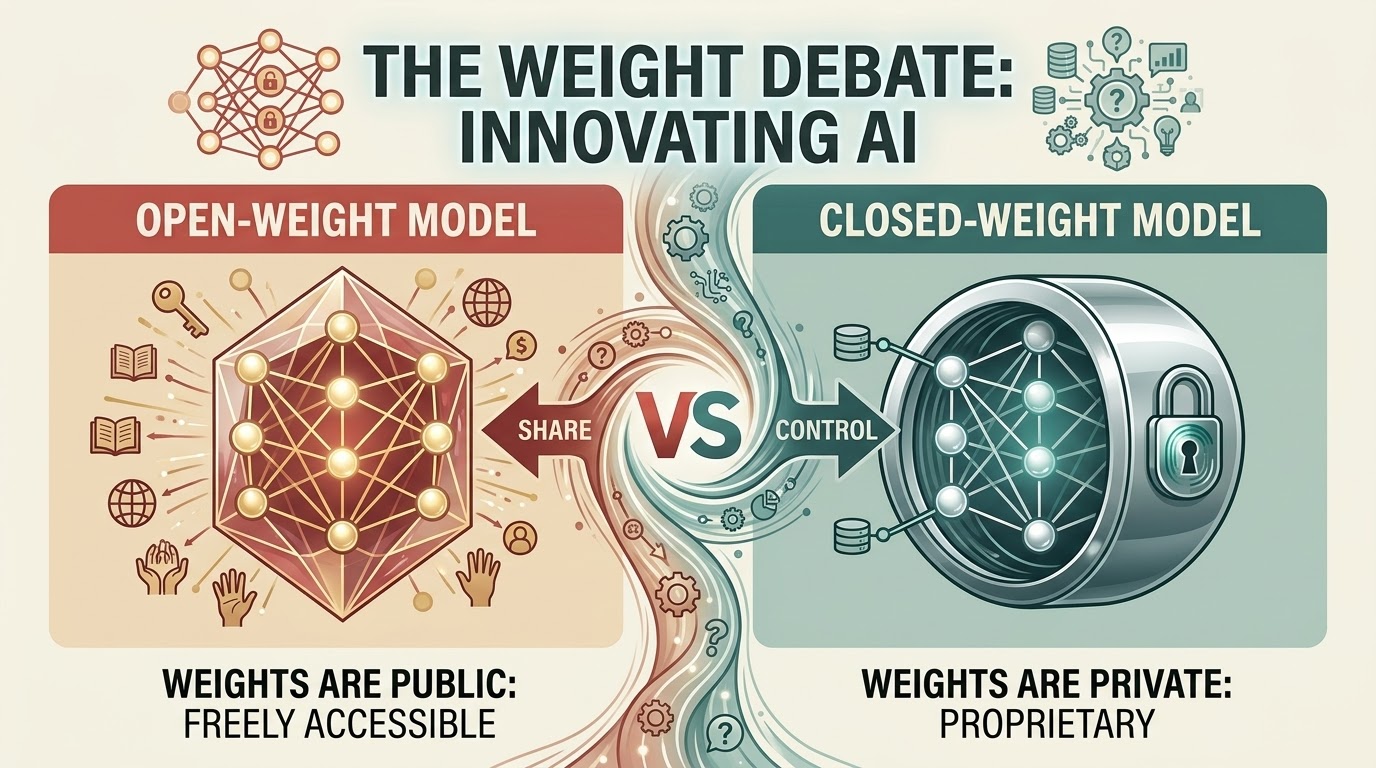
Everyone is talking about open-weight AI models. You can download them. You can run them. You can even build products on them.
So they must be free, right?
Not even close.
This study breaks down what AI models actually cost in 2026 — split into open-weight and proprietary models — and shows why "open" is not the same as "free."
But before we dive in, let's understand the basic unit of AI pricing: the token.
Before We Start: What Is a Token?
AI models don't read words like humans do. They break text into small pieces called tokens.
A token is roughly 4 characters or about ¾ of a word in English.
| Text | Tokens |
|---|---|
| "Hello" | 1 |
| "Artificial intelligence" | 2 |
| "ChatGPT is amazing" | 4 |
| "I love learning about AI models" | 7 |
When you use an AI model through an API, you pay per 1 million tokens. There are two types:
Input tokens — the text you send to the model
Output tokens — the text the model sends back
Output tokens almost always cost more than input tokens — usually 5 to 6 times more. Generating new text takes more computing power than reading existing text.
So when you see "\(1.25 input / \)10 output per 1M tokens," you pay $1.25 for every million tokens you send, and $10 for every million the model generates. Long answers get expensive fast.
Now that you understand tokens, let's look at the real costs.
Part 1: Open-Weight Models Are Not Free
Open-weight models are models whose parameters are publicly downloadable. Anyone can grab them.
But three hidden costs come with them:
Hardware. Big models need big machines.
Licenses. Many "open" licenses have strings attached.
People. Someone has to run and maintain the servers.
The License Trap
| Model | License | Commercial Use & Catch |
|---|---|---|
| DeepSeek R1 / V3 | MIT | Free, no restrictions |
| Gemma 4 | Apache 2.0 | Free, no restrictions |
| Phi-4 | MIT | Free, no restrictions |
| GLM-5.2 | MIT | Free, no restrictions |
| OLMo | Apache 2.0 | Free, no restrictions |
| Llama 4 | Llama Community | Free until 700M monthly users |
| Mistral Medium 3.5 | Modified MIT | Commercial supply restriction |
| Kimi K3 | Custom | Revenue share up to 30% for MaaS |
| Grok-2 | Custom | Free only under $1M/year revenue |
| StableLM | Custom | Free only under $1M/year revenue |
| Command R | CC-BY-NC | Research only. No commercial use |
The lesson: MIT and Apache 2.0 licenses are genuinely free. Custom licenses are not. They look open, but they're really "free until you get big."
The Hardware Bill
| Model | Size | Hardware Needed | Rough Cost |
|---|---|---|---|
| Kimi K3 | 2.8T params | Two 8-GPU H200 servers | $320K–$420K+ |
| Llama 4 Maverick | 400B | 8× H100 GPUs | $80K–$120K |
| DeepSeek V3 | 671B | 4–8 datacenter GPUs | $50K–$80K |
| Gemma 4 31B | 31B | One gaming GPU | ~$2,000 |
| Phi-4 | 14B | One gaming GPU | ~$2,000 |
Small models really can be nearly free. Frontier models cannot.
The Break-Even Point
Renting an 8-GPU NVIDIA H100 node on a specialized cloud provider costs roughly $18,000 per month, though major hyperscalers can charge over $70,000 for the same setup.
| Daily Usage | API Cost/Month | Self-Host Cost/Month | Cheaper |
|---|---|---|---|
| 1M tokens | $150 | $18,221 | API |
| 50M tokens | $7,500 | $18,221 | API |
| 100M tokens | $15,000 | $18,221 | API |
| 500M+ tokens | — | — | Self-host |
Simple rule: Unless you're processing over 100–500 million tokens per day, self-hosting a big open model costs more than just paying for an API.
Part 2: Proprietary Models — Pay As You Go
Proprietary models are rented, not owned. You send text, you get answers, you pay per token.
| Model | Company | Input $/1M | Output $/1M |
|---|---|---|---|
| GPT-5.5 | OpenAI | $5.00 | $45.00 |
| GPT-5 | OpenAI | $1.25 | $10.00 |
| GPT-5 mini | OpenAI | $0.25 | $2.00 |
| GPT-5 nano | OpenAI | $0.05 | $0.40 |
| Claude Opus 5 | Anthropic | $5.00 | $25.00 |
| Claude Sonnet 5 | Anthropic | $2.00 | $10.00 |
| Gemini 3.8 Flash | $0.75 | $3.75 | |
| DeepSeek V4 Pro | DeepSeek | $0.66 | $1.98 |
| Kimi K3 | Moonshot AI | $3.00 | $15.00 |
The good news: no license negotiations, no user caps, no hardware. You just pay the bill.
Two things to watch:
Output costs more than input — usually 5–6× more.
Batch processing is 50% cheaper if you don't need answers immediately.
Part 3: Cost vs. Accuracy
Here's the big question: how much accuracy do you lose by going cheap?
General Knowledge (MMLU-Pro)
| Model | Type | Score | Input Cost |
|---|---|---|---|
| Qwen3.7 Max | Proprietary | 89.6% | API only |
| Claude Opus 4.5 | Proprietary | 89.5% | $5.00 |
| Qwen3.5 397B | Open weight | 87.8% | Self-host |
| Kimi K2.5 | Open weight | 87.1% | $3.00 |
| DeepSeek V4 Pro | Open weight | 87.1% | $0.66 |
| Gemma 4 31B | Open weight | ~85% | Nearly free |
The gap is about 2 points — but the price difference is 40×.
Real-World Coding (SWE-bench Verified)
This is the hard one. It measures whether a model can actually fix real software bugs.
| Model | Type | Score |
|---|---|---|
| Claude Opus 5 | Proprietary | 96.0% |
| Claude Fable 5 | Proprietary | 95.0% |
| Ornith-1.5-397B | Open weight | 86.0% |
| DeepSeek V4 Pro | Open weight | 80.6% |
| MiniMax M3 | Open weight | 80.5% |
| Kimi K2.6 | Open weight | ~75% |
Here the gap is real. For genuinely hard work — complex coding, multi-step reasoning — proprietary models still win.
Part 4: So What Should You Do?
Use open weights when:
Your task is simple (summarizing, sorting, basic chat)
You need data to stay on your own servers
You're processing over 100M tokens/day
You want to avoid vendor lock-in
Use proprietary models when:
The task is hard (complex reasoning, agentic coding)
Your volume is low or medium
You need legal protection against IP claims
You don't want to hire engineers to run servers
The best answer for most teams: use both. Route easy tasks to cheap open models. Send hard tasks to frontier proprietary models.
The Bottom Line
Open-weight models changed the game. They can cut your costs by 80–95% while giving up only a few points of accuracy.
But three things stay true:
Downloading is free. Running is not. A frontier open model can cost $300K+ in hardware.
"Open" licenses often have limits. Only MIT and Apache 2.0 are truly free.
Someone has to maintain it. Budget for engineering time, not just GPUs.
The smartest teams in 2026 aren't choosing sides. They're mixing both.
References
MillionMiner. "AI Server Price Guide 2026: Rent Vs Buy." September 9, 2026.
IntuitionLabs. "Open-Weight AI Model Licenses: Commercial Use Rules Explained." September 5, 2026.
Taskade. "10 Best Open-Source LLMs, August 2026." May 23, 2026.
BenchLM. "Self-Hosting vs API: Break-Even Calculator for Open-Weight LLMs." July 3, 2026.
OpenAI. "Pricing." OpenAI API, 2026.
Anthropic. "Claude Opus 5 Pricing." July 24, 2026.
Google. "What's new in Gemini 3.8 Flash." September 3, 2026.
BenchLM. "MMLU-Pro Leaderboard & Scores — September 2026." September 9, 2026.
BenchLM. "SWE-bench Verified Leaderboard (September 2026)." September 10, 2026.
Meta. "Llama 4 Community License Agreement." April 5, 2025.
Hugging Face. "Kimi K3 License." July 30, 2026.
Reuters. "China's DeepSeek to make permanent 75% price cut on flagship V4-Pro AI model." May 23, 2026.
All pricing and benchmark data reflects publicly available information as of September 2026. Verify current terms and pricing before making procurement decisions.