

Why AI Agents Need Governance—and How Qodo Provides It
Control and governance are necessary for AI agents. Qodo offers a solution.
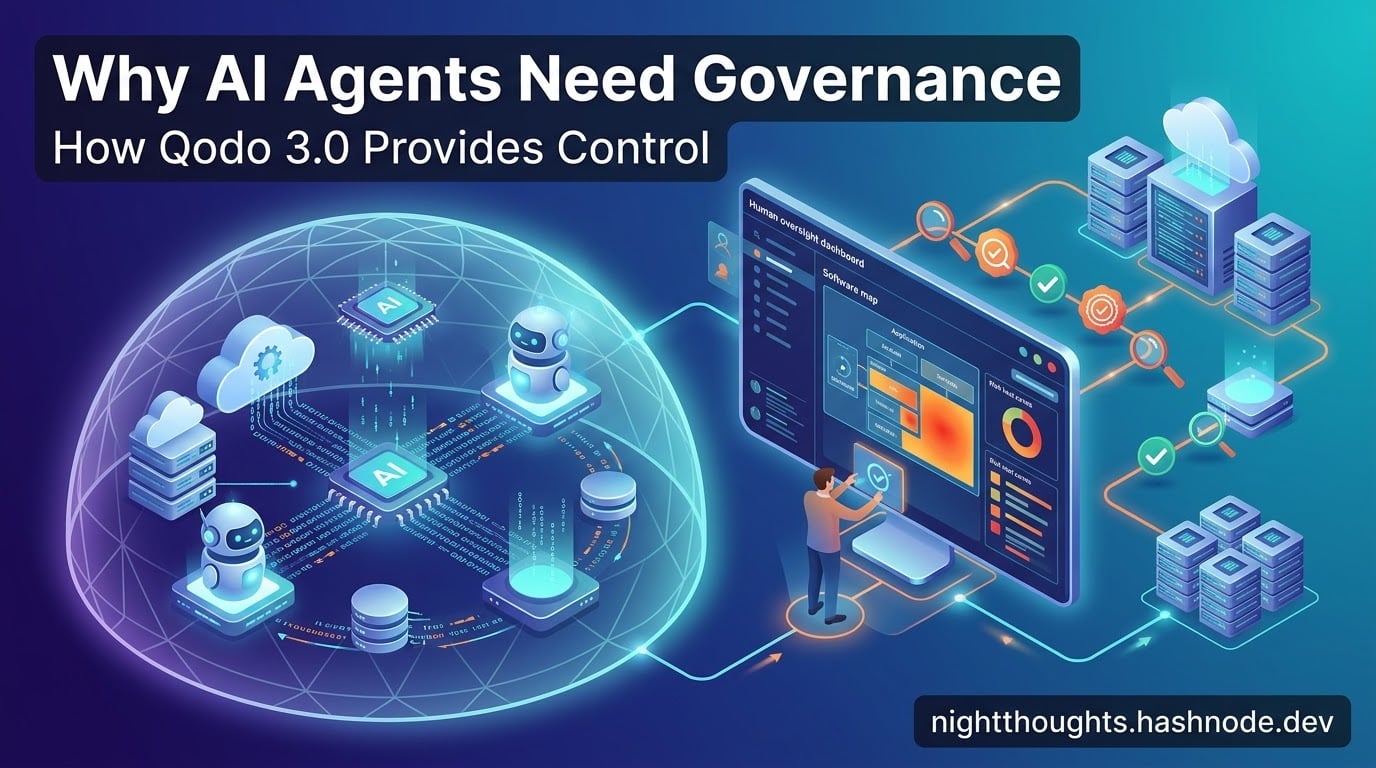
AI agents can now write code. They can open pull requests, fix bugs, and add features at a speed humans cannot match. They do not get tired. That sounds like a big win for software teams.
But speed alone is not enough. If many agents write code at the same time, teams can lose control. Code may not follow company rules. Reviews may pile up. No one may see the full picture. A small change in one place can break something far away. A missed review can become a security problem. This is why control and governance are necessary.
Control means setting clear rules. Governance means making sure those rules are followed and that people can see what is happening. With AI agents, this is hard because work is spread across many repositories and pull requests. Teams need a way to guide agents, review their work, and understand the impact of their changes.
What Is Qodo?
Qodo is a platform that provides a quality and governance layer for software built with AI agents. The company was founded in 2022 by Itamar Friedman and Dedy Kredo. It was originally called CodiumAI and rebranded to Qodo in 2024 as the platform grew beyond just test generation. The founders have deep technical backgrounds: Friedman previously founded Visualead, which was acquired by Alibaba, and led machine vision work at Alibaba. [1]
The Team and Backing Behind Qodo
Qodo is backed by serious investors and advisors. The company has raised a total of $120 million, including a $70 million Series B round in March 2026. The round was led by Qumra Capital, with participation from Square Peg, Susa Ventures, TLV Partners, Vine Ventures, and others. Individual investors include Peter Welinder, VP of Product at OpenAI, and Clara Shih, VP of AI at Meta. [2]
The advisory board includes leaders from OpenAI, Meta, Shopify, and Snyk. This matters because it shows that people who understand both AI and enterprise software believe in what Qodo is building. The company is headquartered in New York. [3]
Why Qodo Is Promising
Qodo is not just another code review tool. It focuses on a problem that most tools ignore: understanding how a code change fits into the whole system. Most AI review tools look at what changed in a single pull request. Qodo looks at how that change affects the entire codebase, considering organizational standards, historical decisions, and risk tolerance.
The company’s CEO, Itamar Friedman, explained the thinking behind this: “Code generation companies are largely built around LLMs. But for code quality and governance, LLMs alone aren’t enough. Quality is subjective. It depends on organizational standards, past decisions, and tribal knowledge.” [4] This insight is the core of why Qodo exists.
The results speak for themselves. Qodo has an F1 score of 64.3% on the Code Review Bench, catching real problems at nearly twice the rate of others, including Claude. It is also ranked #1 by Gartner for code understanding in the Critical Capabilities for AI Assistants Report. Enterprises use it to catch an average of 800 bugs per month. [5]
How Qodo 3.0 Solves the Governance Problem
Qodo 3.0 is the latest version of the platform, released in October 2026. It adds new features designed specifically for governing AI-generated code at scale. Here is how it works:
PR Triage groups related pull requests across repositories into “work packages.” It scores them by impact, priority, and SLA. A reviewer can claim a package, so the same work is not reviewed twice. This directly addresses the review bottleneck that AI-generated code creates. [6]
Agentic Toolbox lets coding agents use Qodo’s rules and codebase context while they write. This means company standards are applied before a pull request is even opened. The rules come from the organization’s own repositories, so agents work within the right guardrails from the start. [6]
Software Map shows how repositories and services connect. It automatically maps dependencies, service relationships, and contracts. It also calculates the “blast radius” of a proposed change, so teams can see what might break. Quality issues appear as a heat map, making technical debt visible. [6]
Analytics Dashboard shows how the team responds to Qodo findings. It tracks impact (how findings lead to accepted changes), compares activity by repository, and analyzes responses by PR author. This gives managers a clear picture of where quality is improving and where it is not. [6]
Wisdom Base is the knowledge layer underneath everything. It keeps a continuously updated understanding of the codebase, standards, architecture, and pull request history. This is what makes the other features smart. It learns from the organization’s own patterns rather than applying generic rules. [6]
Enterprise deployment options make adoption easier. There is an onboarding wizard, review presets tuned to different goals (catching more issues vs. reducing noise), rules import from specific repositories, and support for air-gapped or on-premises deployment. [6]
Licensing
Qodo uses an open-core model. The core pull request review engine, known as PR-Agent, is open source. It was originally launched under the Apache 2.0 license in 2023. In April 2026, Qodo transferred stewardship of PR-Agent to a community-owned GitHub organization and restored the Apache 2.0 license, moving away from any restrictive terms. This means anyone can use, modify, and distribute the PR-Agent engine freely, and teams can self-host it by supplying their own LLM API keys and compute. [7]
The hosted Qodo Merge platform, along with the enterprise governance features introduced in Qodo 3.0, is closed and proprietary. Pricing follows a per-seat subscription model: a free Developer tier provides 30 PR reviews and 250 IDE/CLI credits per month, the Teams tier costs $30 per active user per month (billed annually), and Enterprise is custom-negotiated with options for self-hosted or on-premises deployment. This hybrid approach gives developers an open-source foundation to build on while providing enterprises with a commercial product that includes governance, analytics, and support. [8]
Why Choose Qodo?
The simple answer is this: Qodo understands that generating code and governing code are different problems. Most tools focus on generation. Qodo focuses on verification, quality, and governance.
Its edge comes from three things: deep context (it understands the whole system, not just one file), enterprise focus (it is built for large organizations with complex codebases), and a team with the right experience (founders who have built and sold companies, advisors from OpenAI and Meta, and investors who understand the space).
AI agents can help us build software faster. But without control and governance, speed can create risk. Qodo 3.0 aims to provide that control. It lets agents work quickly while humans stay in charge. That is the balance modern software teams need.
References
Qodo. “Beyond Intelligence: Qodo’s $70M Series B and the Shift to Artificial Wisdom.” Qodo Blog, March 30, 2026. https://www.qodo.ai/blog/qodo-70m-series-b-shift-to-artificial-wisdom/
Qodo. “We’re on a mission to make code integrity simple.” Qodo About Page. https://www.qodo.ai/about/
Qodo. “Qodo | AI Agents for Code, Review & Workflows.” Qodo Homepage. https://www.qodo.ai/
Qodo. “Critical Capabilities Report.” Qodo Reports, November 21, 2025. https://www.qodo.ai/reports/gartner-critical-capabilities-ai-code-assistance-2025/
Qodo. “What’s new - Qodo Documentation.” Qodo Docs, October 1, 2026. https://docs.qodo.ai/whats-new
Qodo. “Qodo 3.0 Puts Governance at the Center of Agentic Code.” Futurum Group, October 2, 2026. https://futurumgroup.com/qodo-3-0-puts-governance-at-the-center-of-agentic-code/
Qodo. “Qodo Is Handing PR-Agent Over to the Community.” Qodo Blog, April 23, 2026. https://www.qodo.ai/blog/qodo-is-handing-pr-agent-over-to-the-community/
API Evangelist. “Qodo Plans and Pricing.” API Commons, June 21, 2026. https://raw.githubusercontent.com/api-evangelist/qodo/refs/heads/main/plans/qodo-plans-pricing.yml
Qodo. “Qodo Raises $70M in Series B Funding.” FinSMEs, March 30, 2026. https://www.finsmes.com/2026/03/qodo-raises-70m-in-series-b-funding.html
Qodo. “Qodo Ranked #1 AI Code Review Tool in Martian’s Code Review Benchmark.” Qodo Blog, March 15, 2026. https://www.qodo.ai/blog/qodo-ranked-1-ai-code-review-tool-in-martians-code-review-benchmark/