
What Happens When AI Agents Run the Market? A Simple Take on the 'Coasean Singularity'
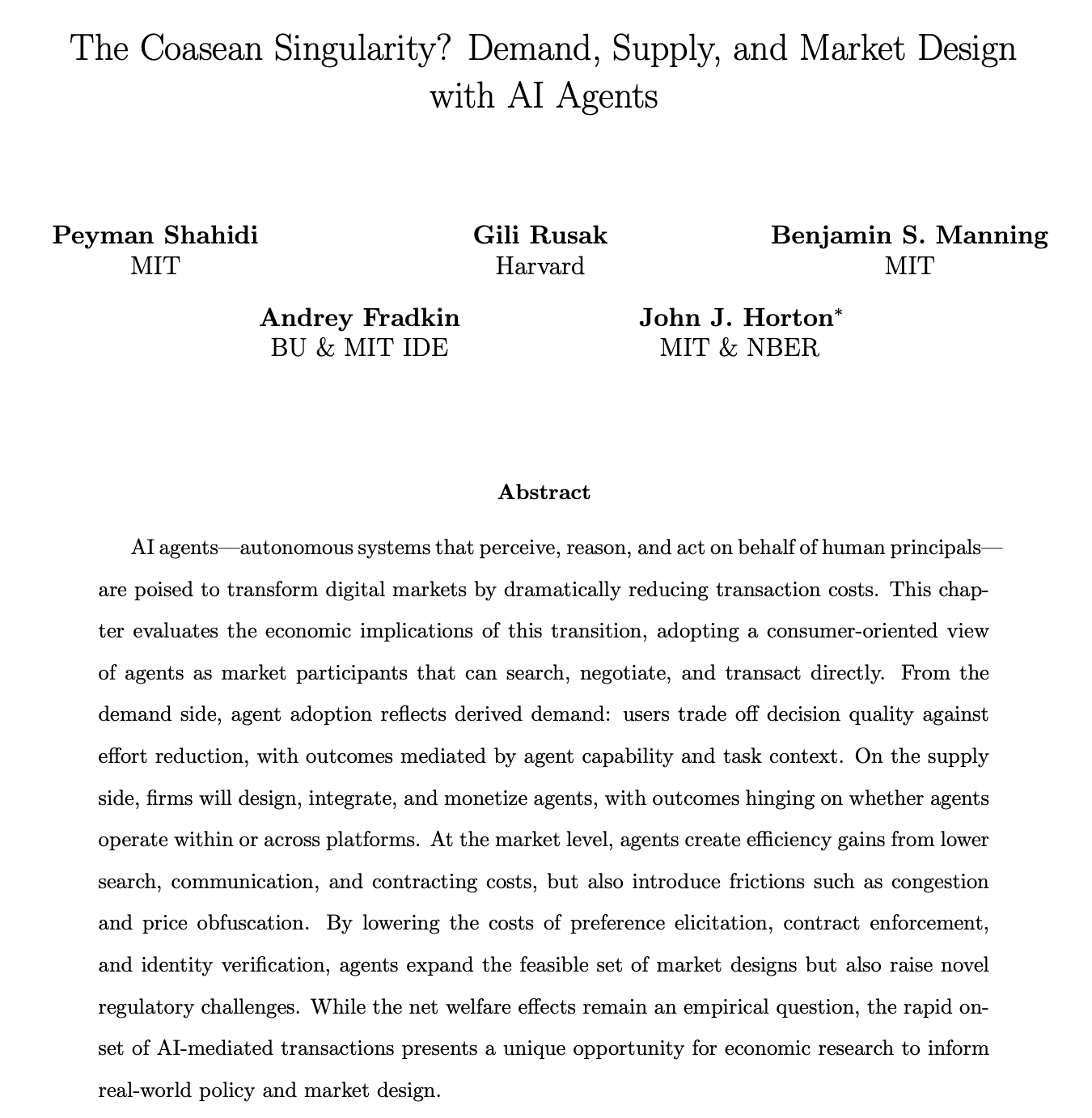
A few months ago, a group of researchers from MIT, Harvard, and BU dropped a chapter in the NBER volume The Economics of Transformative AI that has been buzzing in tech and policy circles. Titled "The Coasean Singularity? Demand, Supply, and Market Design with AI Agents," it asks a big question: What happens to markets when software can search, negotiate, and buy things on your behalf?
Here is the simple version of what they found.
The Big Idea: Transaction Costs Are About to Collapse
In 1937, economist Ronald Coase argued that firms exist because using the market is expensive. Finding prices, writing contracts, and enforcing deals all cost time and money. These "transaction costs" shape the entire economy.
The authors argue that AI agents—autonomous software that can perceive, reason, and act for you—are about to collapse those costs. When software can compare 500 flight options, negotiate your rent, or apply to jobs while you sleep, the old rules of how markets work start to bend. That is what they call the "Coasean Singularity."
Why People Will Want AI Agents (The Demand Side)
People will not use AI agents because they enjoy watching a bot scroll through listings. They will use them because they want better outcomes with less effort. The authors call this derived demand: the agent is just a tool to get what you actually want.
You will probably delegate to an agent when:
- The task is complex or high-stakes (buying a house, hiring, investing).
- There are too many options to evaluate yourself.
- You lack experience or information compared to the other side.
The researchers predict agents will first take off in markets that already rely on human intermediaries or big platforms—think LinkedIn, Zillow, Upwork, and Airbnb. In these markets, agents can do the tedious parts (screening, quoting, scheduling) at nearly zero marginal cost.
But there is a trade-off. Users must balance decision quality against effort reduction. A lazy agent might save you time but miss the best deal. Trust and alignment—making sure the agent actually acts in your interest—become the key design challenges.
Who Will Build Them and How They Will Be Sold (The Supply Side)
On the supply side, firms will design, integrate, and monetize agents. The authors sketch out two big choices every platform will face:
1. Who owns the agent?
- Bring-your-own (BYO) agent: You control a portable agent that works across Amazon, Walmart, or Airbnb via public APIs. It knows your preferences and stays loyal to you, but platforms may limit its access.
- Platform-provided ("bowling-shoe") agent: The platform gives you the agent. It is deeply integrated and easy to use, but it may nudge you toward the platform's preferred sellers or prices.
2. How specialized is it?
- Horizontal agents are generalists that handle many tasks across many sites.
- Vertical agents are specialists for one domain—taxes, travel, job search—trading breadth for depth.
Because software can be copied cheaply, AI agents will not command the same hefty commissions as human brokers. Pricing may look more like today's digital services: free with ads, bundled into subscriptions, or tiered freemium models. However, if better performance requires more compute, prices could still scale with the stakes of the transaction.
What Happens to Markets?
The authors see a mix of huge opportunities and new risks.
The good: Agents slash search, communication, and contracting costs. They can make more rational decisions than tired or biased humans, which erodes business models built on consumer confusion—like tricky phone contracts or hidden fees. Over time, clearer demand signals could push firms to build better products rather than just better ads.
The bad: Cheap automation creates new frictions. If every job seeker uses an agent to customize 1,000 applications, employers drown in noise. That is congestion. Firms may also respond with price obfuscation—hiding true costs behind complex structures that even agents struggle to decode. And because agents can mimic humans, verifying who is real online becomes harder, opening the door to spam and fraud.
New Market Designs We Could Finally Build
Perhaps the most exciting part is that agents unlock market designs that were previously too expensive to run.
For example, matching markets (jobs, schools, organ donations) could use sophisticated algorithms like deferred acceptance, which require participants to rank thousands of options. Humans cannot do that easily, but agents can. Agents can also act as privacy shields: a job seeker might have their agent ask about parental leave policy anonymously, avoiding the signaling risk of asking directly.
In short, agents expand the feasible set of market designs by making it cheap to elicit preferences, enforce contracts, and verify identity.
The Regulatory Wild West
The authors do not ignore the policy challenges. They highlight three:
- Market power: If only a few firms control the best foundation models, they could lock users into walled gardens and limit interoperability.
- Autonomy and liability: If your agent signs a bad contract or makes a discriminatory hiring decision, who is responsible—you, the platform, or the developer?
- Security and privacy: Agents trained on your data might leak sensitive information or be jailbroken by bad actors.
The Bottom Line
The paper does not claim that AI agents will automatically make the world better. Instead, it frames the transition as a massive, fast-moving economic experiment. The net welfare effects are still an open question. But one thing is clear: the rise of agentic transactions is not just a tech story—it is a market-design story.
For builders, the takeaway is that the interface of the future may not be a website for humans at all. It may be an API for agents. And for the rest of us, the takeaway is simpler: soon, you might have a tireless digital representative negotiating on your behalf. Whether that representative truly serves your interests—or the platform that built it—is the question we all need to watch.
Reference
- Paper: Shahidi, P., Rusak, G., Manning, B., Fradkin, A., & Horton, J. J. (2025). The Coasean Singularity? Demand, Supply, and Market Design with AI Agents. NBER Chapter in The Economics of Transformative AI.
URL: https://www.nber.org/books-and-chapters/economics-transformative-ai/coasean-singularity-demand-supply-and-market-design-ai-agents