
Security and Governance: The Guardrails That Make AI Safe to Use
Why the endless possibilities of AI need protection and direction to be trusted
Artificial intelligence offers seemingly endless possibilities. It can write, design, diagnose, forecast, negotiate, and increasingly act on our behalf. The potential feels unlimited: faster decisions, lower costs, new services, and solutions to problems once thought unsolvable.
But as AI moves from answering questions to taking action, that potential introduces a new kind of risk. A bad output is inconvenient. A bad action can cost money, expose data, disrupt operations, or cause harm. The question is no longer only "What can AI do?" but "What should AI be allowed to do, and how do we keep it safe?"
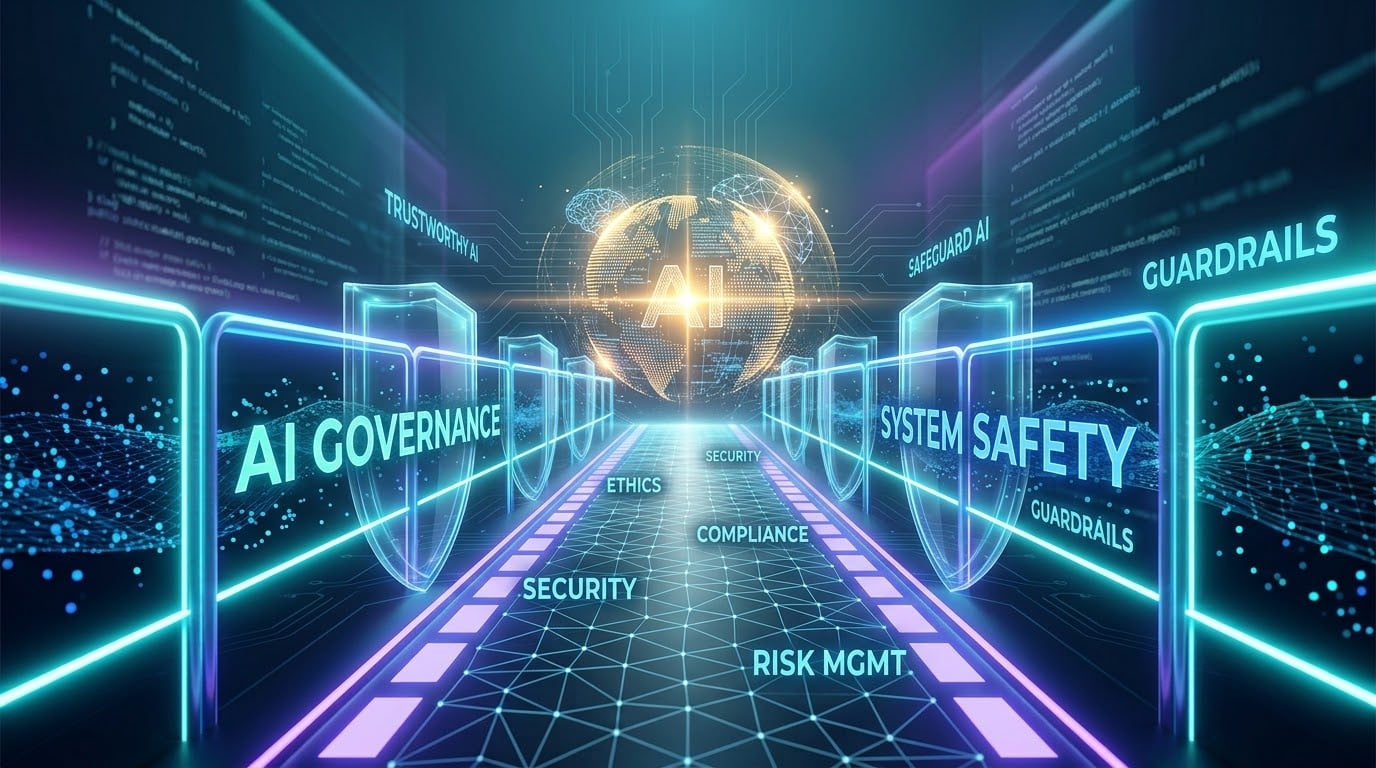
The answer lies in two complementary ideas: security and governance. Together, they form the guardrails that make it possible to move quickly without crashing.
What Are AI Guardrails?
A guardrail does not stop a car from moving. It keeps the car on the road when something goes wrong. The same applies to AI.
AI guardrails are the combination of technical controls and organizational rules that keep AI systems safe, accountable, and aligned with human intent. They rest on two pillars.
Security: the lock. Security asks: Can someone misuse this? It protects the AI system from being manipulated, attacked, or broken—and protects people and organizations from the consequences when AI fails.
Governance: the rulebook. Governance asks: Should this be allowed, by whom, and how do we know? It covers policies, approvals, human oversight, audit logs, and accountability.
Neither works alone. Security without governance is a locked door with no rules about who gets a key. Governance without security is a rulebook sitting next to an open vault.
| Security | Governance | |
|---|---|---|
| Focus | Protection | Direction |
| Question | Can someone misuse this? | Should this be allowed, by whom, and how do we know? |
| Analogy | The lock and alarm | The rulebook and referee |
| Examples | Access controls, encryption, monitoring | Policies, approvals, audit logs, oversight |
Guardrails are not barriers to innovation. They are what make innovation sustainable, because they allow AI to be trusted with greater responsibility.
Security: Protecting AI and Protecting from AI
Security focuses on one question: Can someone misuse this? As AI gains access to databases, money, and machines, the attack surface expands. Common risks include:
Prompt injection — tricking the AI into ignoring its instructions.
Data leakage — exposing private or sensitive information.
Unauthorized access — gaining entry to the AI system or its data.
Model theft — stealing the AI model itself.
Supply chain vulnerabilities — compromised third-party tools, libraries, or data.
Security controls reduce these risks. Access controls ensure only authorized users and systems can interact with the AI. Encryption protects data at rest and in transit. Least privilege limits the AI to the minimum permissions it needs. Monitoring and logging record important actions for review. Regular security testing finds vulnerabilities before attackers do.
Security is the lock on the door and the alarm on the wall. It does not decide what the AI should do. It ensures only the right actors get in, and that anything unusual is detected and recorded.
Governance: Rules, Roles, and Accountability
Governance decides what the system is allowed to do. It answers: Should this be allowed, by whom, and how do we know?
An AI system can be perfectly secure and still cause harm. It can make unfair decisions, violate regulations, or act beyond its scope. Governance provides direction, boundaries, and oversight.
Core elements include:
Policies and acceptable use — written rules about what AI can and cannot be used for.
Approval workflows — defined steps for who approves an AI system and which actions require sign-off.
Human-in-the-loop — a human reviews and confirms the AI's recommendation before high-consequence decisions take effect.
Audit logs and traceability — every important action is recorded, enabling investigation and accountability.
Risk classification — systems are sorted by risk level, with stricter controls applied where stakes are higher.
Compliance and ethics — ensuring AI meets legal, regulatory, and ethical standards, including privacy, fairness, and transparency.
Governance is the rulebook and the referee. It does not play the game. It makes sure the game is played fairly and according to agreed rules.
How Security and Governance Work Together
Each pillar covers what the other cannot.
Security without governance is a hardened system with no policy defining what it should or should not do. It remains protected from outsiders, but it can still make harmful or non-compliant decisions.
Governance without security is a detailed rulebook with no enforcement. The rules exist, but the system can be tricked or hacked into ignoring them.
Together, they create safe autonomy: an AI system that is protected from misuse and operates within clearly defined boundaries. This is the foundation of trust, and trust is what allows AI to move from controlled experiments to real-world impact.
Real-World Applications
Customer service AI answers questions, processes refunds, and escalates complex issues. Security protects against prompt injection and unauthorized access to customer records. Governance sets refund limits and requires human approval above a threshold. Every action is logged.
Healthcare AI assists with diagnosis and treatment recommendations. Security protects patient data and restricts access to authorized staff. Governance requires a licensed clinician to approve any AI-generated diagnosis or treatment plan, with audit trails recording who saw what and when.
Self-driving systems control steering, acceleration, and braking. Security protects vehicle software from being hacked and sensor data from being spoofed. Governance sets safety standards, operational limits, and incident reporting requirements, with regulations defining responsibility when something goes wrong.
Enterprise AI agents automate workflows such as scheduling, expense approval, and supply chain management. Security applies least privilege and monitors for unusual activity. Governance defines spending limits, approval chains, and which actions require human confirmation.
Finance and banking uses AI for fraud detection, credit scoring, loan approvals, wealth management, and customer service. It can also act as an agent that moves money or rebalances portfolios. Security protects against data breaches, unauthorized transactions, and model theft. Governance is especially strict here: credit-scoring and loan-approval AI is classified as high-risk under regulations like the EU AI Act, making human oversight, data governance, and explainability mandatory. For AI agents that move money, governance sets predefined mandates, and every proposed action is validated and recorded before it executes. Audit logs are required for compliance. The AI can act, but only within approved, monitored, and recorded rules.
In every case, security protects the system and the data. Governance defines what the AI may do, who approves it, and how we know what happened.
Frameworks for AI Security and Governance
Frameworks are structured guides—recipes, not rigid rules—that organizations can adapt to their own needs.
NIST AI Risk Management Framework (AI RMF) is a voluntary framework built around four functions: Govern (establish roles and policies), Map (understand where AI is used and what could go wrong), Measure (assess risks consistently), and Manage (reduce risks and monitor results). It also defines what trustworthy AI looks like: valid, safe, secure, accountable, transparent, explainable, privacy-enhanced, and fair. It is free, sector-agnostic, and widely used as a starting point.
ISO/IEC 42001 is the first international certifiable standard for an AI Management System. Where NIST offers guidance, ISO/IEC 42001 allows formal certification, demonstrating to customers, regulators, and partners that AI is managed responsibly. It applies to any organization that builds, buys, or uses AI.
OWASP GenAI Security Project maintains the Top 10 for LLM Applications, updated annually based on real-world incident data. The 2026 edition ranks prompt injection, sensitive information disclosure, and excessive agency as the top three risks. A companion Top 10 for Agentic Applications focuses on what autonomous systems are allowed to do once they move from reasoning to action.
EU AI Act is a binding regulation that classifies AI systems by risk level. Creditworthiness and credit-scoring systems are explicitly high-risk, triggering requirements for human oversight, data governance, transparency, and conformity assessment.
MAS SAFR (Safeguards for Agentic Finance at Runtime) was developed by the Monetary Authority of Singapore for AI agents in financial services. It introduces governance checkpoints that verify and record an agent's proposed actions before they execute, keeping behavior within predefined mandates and risk boundaries. It has been applied to agent-assisted payments, wealth management, and client engagement.
These frameworks differ in scope and formality, but they share a core idea: AI should operate within clearly defined boundaries, with oversight, transparency, and accountability. Start with one and build from there.
Practical Checklist
Inventory your AI tools and data access. Know what systems are in use, what data they can reach, and what actions they can take.
Apply least privilege. Give each system only the minimum permissions it needs.
Log all important actions. Record what the AI does, when, and who or what initiated it.
Require human approval for high-risk tasks. Define which actions are too consequential to automate fully.
Test for prompt injection and data leakage. Probe your systems regularly and fix what you find.
Write a simple AI use policy. Document what is allowed, what is prohibited, who approves new use cases, and how incidents are reported.
Review and update regularly. Capabilities, risks, and regulations evolve quickly. What was safe six months ago may not be safe today.
Security and governance are ongoing practices, not one-time projects.
Conclusion
AI offers seemingly endless possibilities, and those possibilities are growing. But as AI moves from answering questions to taking action, the risks grow with it.
Security and governance are the guardrails that make it possible to explore those possibilities safely. Security protects AI systems from being hacked, tricked, or misused. Governance defines what AI is allowed to do, who approves it, and how we know what happened. Together, they create safe autonomy—the ability to trust AI with greater responsibility because the boundaries are clear and the protections are in place.
Frameworks like the NIST AI RMF, ISO/IEC 42001, and the OWASP Top 10 for LLM Applications provide practical blueprints. Real-world examples from customer service, healthcare, self-driving systems, enterprise agents, and finance show that guardrails are already being applied in production systems today.
Trust leads to adoption. Adoption leads to value. Guardrails are what make that journey possible.