

Jev: The AI That Doesn't Talk — It Decides
Most AI tools today are like chatbots. You ask a question. They write a long answer. That is useful. But it is also slow and expensive. A new AI called Jev is different. It does not write text. It makes decisions. Jev comes from TypeSafe AI. The company was started by Diogo Almeida. He is a former OpenAI researcher. He helped build InstructGPT and RLHF. Those are key ideas behind ChatGPT. Now he is building something new.
What Is Jev?
Jev is a "System One Model." That means it is built for fast, automatic decisions. You give it input. The input can be an email, a message, or some data. Then you ask it questions. But you must give it possible answers. Jev does not write a paragraph. It returns structured answers.
For example: Is this urgent? Yes, 95% chance. Which team should handle it? Billing. How angry is the customer? 1.27 on a scale of 0 to 2. Software can use these answers right away.
Why Is It Different?
Large language models like ChatGPT generate text word by word. That takes time. It also costs money. Jev does not generate text. It answers all questions in one pass. This makes it very fast. It also makes it cheap.
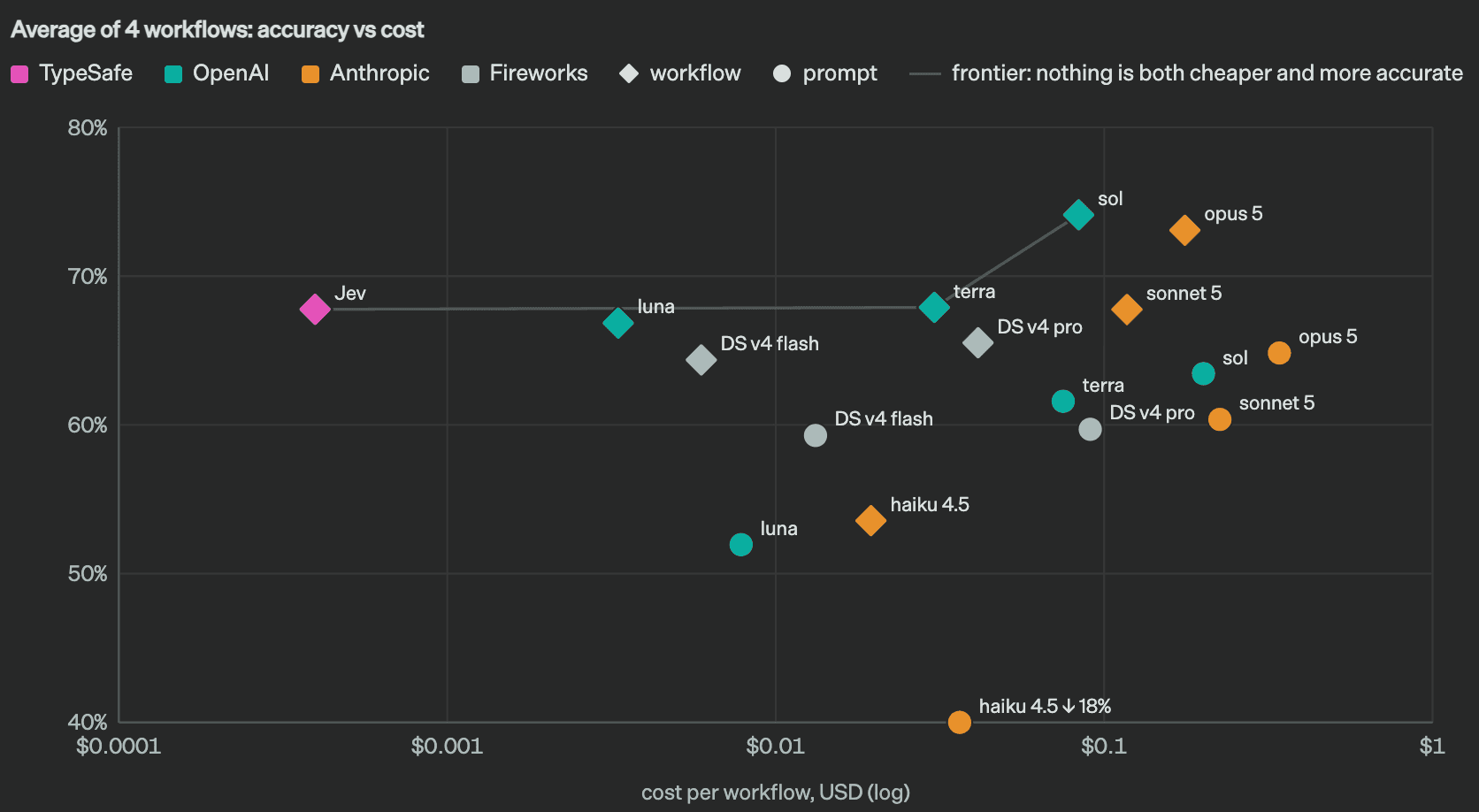
According to TypeSafe, Jev can be up to 193 times faster than large models. Its response time is 70 to 500 milliseconds. Large models can take 3 to 329 seconds. That is a big difference.
Cost and Accuracy
Jev is also very cheap. Input costs $0.042 per million tokens. Output tokens are free. TypeSafe says it can be up to 444 times cheaper than LLMs for some tasks.
In internal tests, Jev reached 67.8% accuracy. GPT-5.6 Terra reached 67.9%. So the accuracy is close. But Jev is much faster and cheaper. These numbers come from TypeSafe's own tests. Independent tests are still limited. But early results are promising.
How Does It Work?
Jev has three main question types.
- Noul: It asks if something is true. The answer is a probability from 0 to 1.
- Choice: It asks which option fits best. The answer is one option plus a probability.
- Score: It asks where something falls on a scale. The answer is a score.
For example, take this customer message: "My payouts have failed for three days and nobody has replied. Please help ASAP."
Jev can answer:
- Is it urgent? 0.95
- Which department? Billing, 0.95
- How frustrated? 1.27 on a 0 to 2 scale
All in one quick response.
No Hallucinations
One big problem with LLMs is hallucination. They can make things up. Jev cannot do that. Why? Because you define the possible answers in advance. Jev only returns probabilities for those answers. It does not write free text. So it cannot invent facts or sentences. This makes it safer for automation.
Real Use Cases
Developers are already using Jev for many tasks.
Vercel used it to check if commands are safe. It was 5 to 18 times faster than an LLM and more accurate.
A CTO tested Jev for sorting business emails. Gemini was a little more accurate, but 10 to 20 times more expensive. The best part was Jev's real probability scores. That makes it easy to automate decisions.
Other uses include:
- Watching AI agents
- Preventing jailbreaks
- Routing tasks to the right model
- Picking tools for agents
- Processing large data sets
Limits
Jev is not a replacement for ChatGPT. It cannot write articles, chat, or code. It cannot explain its answers in words. You must know the possible answers before you ask. If you need creative text, Jev is not for you.
Also, most benchmarks are from TypeSafe. We need more independent tests. And because Jev does not explain itself, it can be hard to check why it made a decision.
The Bigger Picture
For years, developers used one big model for everything. Jev suggests we should split tasks. Many tasks in AI pipelines are not really about writing. They are about routing and classifying. Those tasks do not need a chatbot. They need a decision model. This is where Jev fits.
It also connects to the Jevons Paradox. That idea says when something becomes cheaper, people use more of it. If decisions become very cheap, we will automate many more decisions. So Jev may not reduce AI use. It may increase it.
Conclusion
Jev is not a better ChatGPT. It is a different kind of AI. It does not talk. It decides. It is fast, cheap, and hard to trick. It is best for automation, sorting, routing, and guardrails. It is not for conversation or creative work.
If you build software that needs quick, reliable choices, Jev is worth watching.