
Technical Breakdown of Ornith-1.5-122B: Impressive Data, MoE Architecture, and Licensing Caveats
Ornith-1.5-122B was released on October 20, 2026, positioning itself as an efficient Mixture-of-Experts (MoE) model designed for single-GPU deployment. Its marketing centers on three claims: state-of-the-art (SOTA) performance among comparable open-source models, the ability to run on a single NVIDIA DGX card, and an MIT license.
For developers, these claims need to be broken down. Some are supported by clear documentation, while others have significant caveats that are easy to overlook.
Who is Behind Ornith?
The Ornith series is developed by DeepReinforce, a research-focused startup founded by Jiwei Li. Li holds a Ph.D. in Computer Science from Stanford University and previously founded the NLP startup Shannon.AI. DeepReinforce publicly positions itself as focusing on reinforcement-learning-based agentic AI systems. Their previous work includes GrandCode (a multi-agent system that ranked first in Codeforces competitions) and the code optimizer IterX. The first models in the Ornith-1.5 series (397B, 35B-A3B, 9B) were released in August 2026, with the 122B model serving as a subsequent mid-sized addition.
(Note: While third-party AI news outlets report this attribution, it is recommended to verify these details directly on the official Hugging Face model card or company site.)
Architecture & Foundation: A MoE on Top of Qwen 3.5
Ornith-1.5-122B is not a from-scratch model. According to the official model card, the Ornith-1.5 series is built upon the foundation of Ornith-1.0, which itself was created through continued pre-training, mid-training, and post-training on top of Qwen 3.5 and Gemma 4.
The specific architecture of the 122B version directly follows Qwen3.5-122B-A10B: a total parameter count of roughly 122B, with approximately 10B parameters activated per inference.
The key here is the Mixture-of-Experts (MoE) structure. While the total parameter count is large, only a fraction is activated during each forward pass. This is the architectural prerequisite that allows it to compress its inference VRAM footprint. The model supports a 256K native context window (extendable to roughly 1 million tokens via YaRN), image understanding, tool calling, and outputs explicit "thinking blocks."
Benchmarks: Solid Numbers, But Read the Fine Print
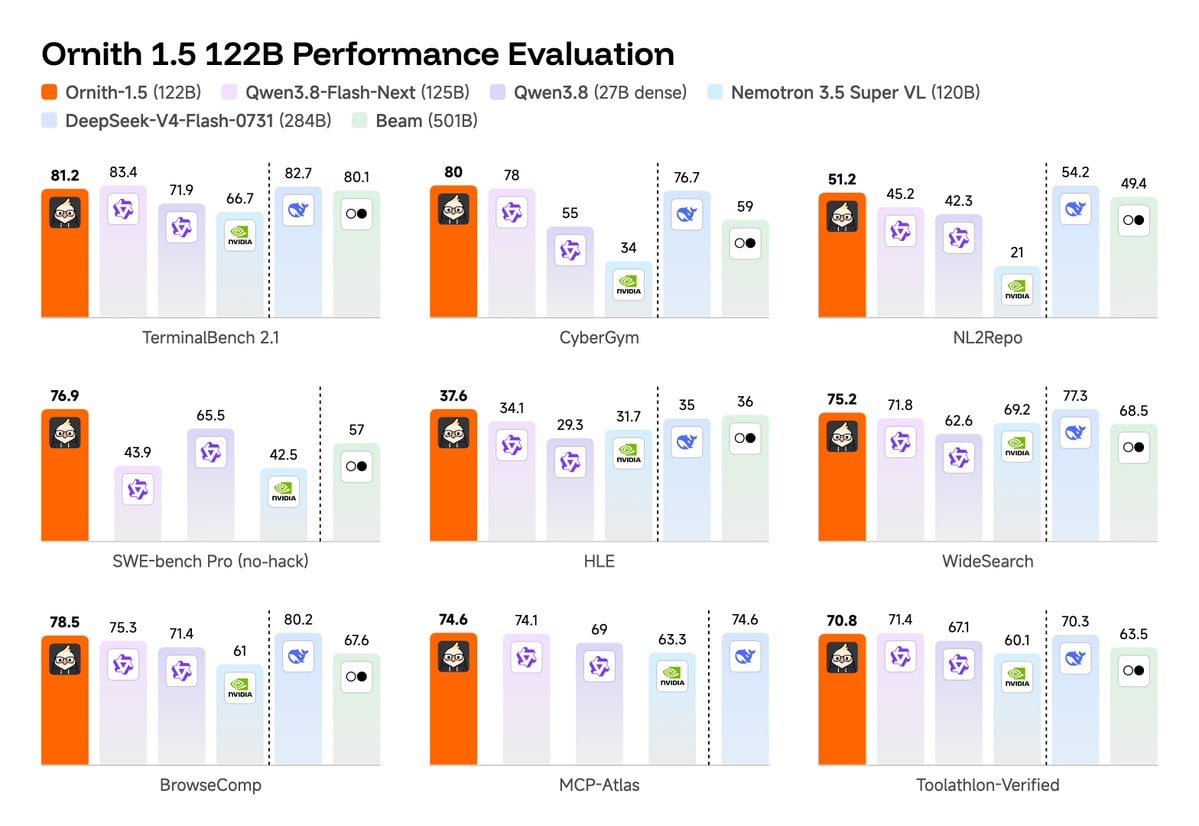
Ornith's published benchmark data is indeed leading among models of its size, particularly in coding and agentic tasks. The following data comes from the official model card and the third-party tracking platform BenchLM:
Coding Capabilities
- SWE-bench Verified (anti-hacking setup): 84.5% (vs. Qwen3.8-Flash-Next at 82.8%)
- SWE-bench Pro (anti-hacking setup): 76.9% (vs. Qwen3.8-Flash-Next at 43.9%)
- Terminal-Bench 2.1: 81.2% (slightly below Qwen3.8-Flash-Next at 83.4%)
- CyberGym: 80.0% (vs. Qwen3.8-Flash-Next at 78%)
Reasoning & Agentic Capabilities
- HLE (with tools): 48.0% | HLE (without tools): 37.68%
- BrowseComp: 78.5%
- MCP-Atlas: 74.6% | Toolathlon-Verified: 70.8%
Caveats to the Testing Conditions
First, these benchmark scores are currently self-reported by the developers. BenchLM explicitly notes that Ornith-1.5-122B "is tracked, but has not yet entered public rankings," and its data is categorized as "officially reported results" that have not yet been replicated at scale independently.
Second, the SWE-bench series used an "anti-hacking" setup: The model was explicitly evaluated with safeguards against reward hacking, meaning any solutions that still exhibited such behavior were marked as incorrect. This design increases the credibility of the scores but also means they cannot be directly compared to scores run without equivalent constraints.
Third, the two HLE scores must be viewed separately: 48.0 is achieved when the model is allowed to use tools, whereas 37.68 is the raw reasoning performance without external tools.
The "Single DGX" Claim: Conditionally True
The official model card and multiple sources confirm that the 122B version is designed to be deployable on a single GPU with 80GB of VRAM. This is architecturally sound because the MoE activates only ~10B parameters, and quantization can significantly reduce weight memory usage. The team has also released FP8, GGUF, and NVFP4 quantized versions to further lower the barrier to entry.
However, "can load" does not mean "runs comfortably." Taking the GGUF quantized version as an example, the attention cache overhead is roughly 24 KB per token, corresponding to about 0.2 GB for an 8K context and about 0.8 GB for a 32K context. This means that after loading the weights on an 80GB card, the remaining VRAM for KV cache, batching, and context windows is limited. If you need long contexts or high concurrency, a single card will still be strained.
The SGLang documentation lists a reference configuration of 8× H100 or H200 for BF16 precision. This indicates that "single card" is an optimization target for specific quantized configurations and lightweight workloads, rather than the default way to run it at full precision.
The MIT License: A Detail Worth Verifying
One of the core selling points highlighted by Ornith is the MIT license. The official model card explicitly states "Open weights under the MIT license." If the license file is indeed valid and compliant, this is a massive convenience for commercial adoption—MIT allows for unrestricted download, modification, and redistribution.
However, there is an issue developers should note. When reviewing the model, BenchLM pointed out: "The model card claims open weights under an MIT license, but the linked LICENSE file is unavailable in the revision reviewed." In other words, there is a gap between the text claim on the model card and the actual license file.
For a model derived from Qwen and Gemma, the licensing compliance chain must be verified layer by layer: whether the foundational license terms of Qwen and Gemma permit republishing a derivative work under MIT is a legal question that needs to be verified, not just assumed based on a sentence on the model card.
Practical Positioning
The reasonable positioning for Ornith-1.5-122B is: a heavily optimized, Qwen-derived MoE model that is competitive on agentic coding tasks. Its self-reported scores on SWE-bench-class tasks are indeed higher than similarly sized baselines, its MIT claim (if verified) is commercially friendly, and single-card quantized deployment is a real possibility.
But it is not a "free surpasses closed-source frontier" model. The no-tools HLE score of 37.68 shows that its raw reasoning still has clear boundaries; the benchmarks have not yet been independently replicated; the actual status of the license file needs to be confirmed; and single-card deployment is constrained by VRAM in terms of context and concurrency.
The recommended evaluation workflow is simple: get the quantization version you need from Hugging Face, run an evaluation on your own real-world tasks (rather than public benchmarks), and verify the license file carefully before making an integration decision.
References
- Ornith-1.5-122B Official Model Card (Hugging Face): https://huggingface.co/ornith-ai/Ornith-1.5-122B-NVFP4
- Ornith-1.5-122B GGUF Model Card: https://huggingface.co/ornith-ai/Ornith-1.5-122B-GGUF
- BenchLM.ai Benchmark Tracking and Review: https://benchlm.ai/models/ornith-1-5-122b
- TheBlockBeats Report on Developers and Architecture: https://en.theblockbeats.news/flash/372992
- AI Tools Review Introduction to DeepReinforce and Jiwei Li: https://aitoolsreview.co.uk/insights/ornith-1-5
- Gigazine Report on Single DGX Deployment and MoE Architecture: https://gigazine.net/news/20261021-ornith-1-5-122b/
- SGLang Deployment Documentation (BF16 Reference Config): https://docs.sglang.io
- There's An AI For That Profile on DeepReinforce: https://free.theresanaiforthat.com/model/ornith-1-5-122b/
About the author
- Father of two, tech lover. Building systems by day, raising curious minds by night.
Comments
Join the discussionNo comments yet. Be the first to comment.